

Article: How to choose a thermometer for the family: a complete guide
How to choose a thermometer for the family: a complete guide
When cold and flu season arrives, the thermometer becomes one of the most used devices at home. But you only need to walk into a pharmacy or an online store to realize there are many options: digital, ear, forehead, with and without contact. Which one is best for your family?
In this guide, we explain the differences between the various types, what you should consider when choosing, how to measure correctly, and when it is time to speak to a healthcare professional.
Quick summary: the 3 types of thermometers
| Type | Measurement site | Speed | Best suited for |
|---|---|---|---|
| Digital contact | Armpit or mouth | A few seconds | Those wanting a simple, budget-friendly option |
| Ear | Ear canal | Very fast | Frequent measurements for the whole family |
| Forehead | Forehead, with or without contact | Very fast | Measuring without waking or disturbing |
1. Digital contact thermometer
This is the classic "pen-shaped" thermometer. It measures temperature in the armpit or mouth, depending on the manufacturer's instructions, and emits a beep when the reading is finished.
- Advantages: economical, easy to use and carry, and requires no accessories.
- Things to keep in mind: it requires the person to stay still during the measurement, which isn't always easy with small children.
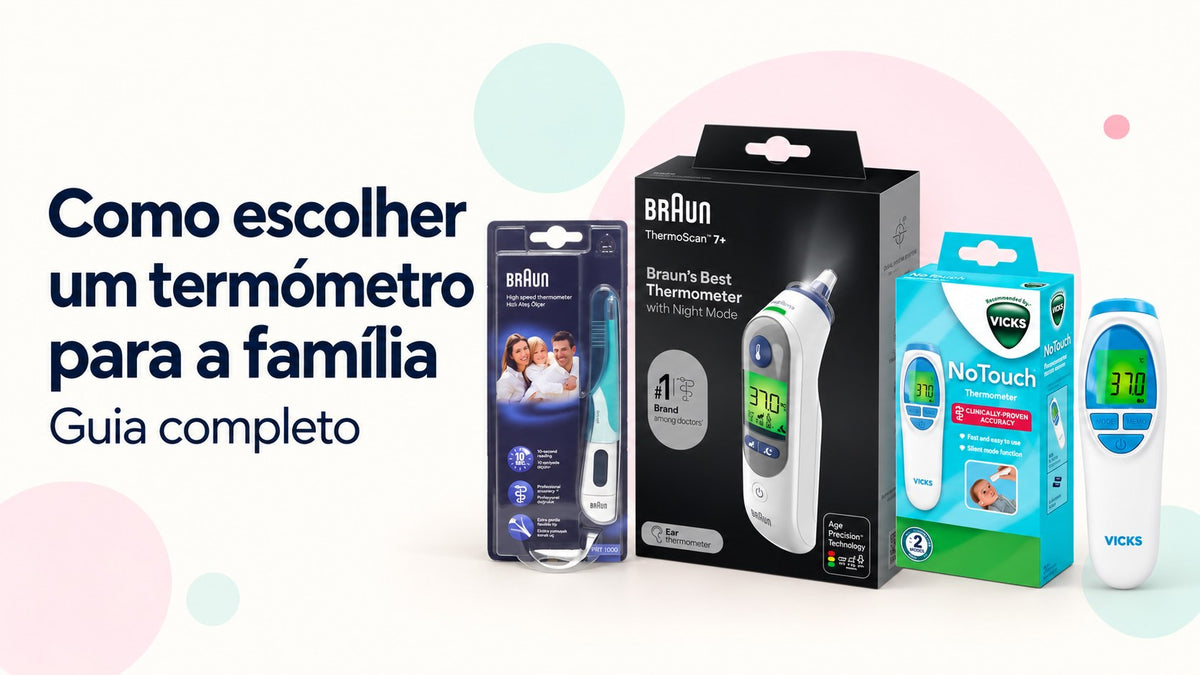
Example: the Braun PRT1000, with a flexible tip and reading in seconds, practical for having at home or taking on trips.
2. Ear thermometer
It uses infrared technology to measure the heat emitted by the eardrum and surrounding tissues. The reading takes only a few moments, making it very practical when you need to measure several times a day.
- Advantages: speed, consistent readings when used correctly, and extra functions in more complete models.
- Things to keep in mind: it uses disposable probe covers, which must be changed for each measurement. The position of the probe in the ear influences the result, so it is advisable to follow the manual.
Examples: the Braun ThermoScan 7+ IRT6525, with AgeSmart technology (which helps interpret temperature according to age), pre-warmed tip, and night mode with soft light and silent mode; and the Braun ThermoScan 3, a simpler option with audible and visual alerts and a protective cap.
3. Forehead thermometer (infrared)
It measures temperature on the forehead, with or without skin contact, depending on the model. As it does not go into the ear or mouth, it is the most comfortable for children and the easiest to keep clean.
- Advantages: quick measurement, no discomfort, and no accessories required. Non-contact models allow you to measure a baby while they are sleeping.
- Things to keep in mind: the reading can be affected by sweat, hair on the forehead, or if the person has just come in from the cold or heat.
Examples: the Braun BNT400, which measures with and without contact and has Age Precision technology, with a color-coded screen adjusted to age; and the Vicks VNT200, non-contact, with a reading in about 2 seconds, green/yellow/red screen, 5-reading memory, and silent mode.
What to look for in a good thermometer
- Age-based reading: functions like AgeSmart or Age Precision help to understand if the temperature is normal or elevated for the age of the person being measured.
- Color-coded and backlit screen: makes reading easier at night and avoids doubts in interpretation.
- Silent mode: useful for measuring a baby or child's temperature while they sleep.
- Memory: saving recent readings helps track progress and provide more complete information to the doctor.
- Hygiene: think about how many people will use the device and how it is cleaned. For ear thermometers, count on the cost of probe covers.
- Simplicity: few buttons and clear instructions make a difference when you are tired and the child is uncomfortable.
Which thermometer to choose for each age
Newborns and babies
A non-contact forehead thermometer allows you to measure without waking the baby. Always follow your pediatrician's guidance on the most appropriate method for your child's age, especially in the first few months.
Children
Speed is the most important factor. An ear or forehead thermometer completes the measurement in seconds, before the child loses patience.
Adults and seniors
Any type will do. For those who have difficulty reading small displays, choose a model with a large, color screen.
How to measure temperature correctly
- Wait a few minutes at rest. Avoid measuring immediately after a bath, exercise, a hot meal, or upon arriving from outdoors.
- Always use the same thermometer and the same site. Normal values vary slightly between the armpit, ear, and forehead, so it only makes sense to compare readings taken in the same way.
- Follow your model's manual. Correct positioning and distance make all the difference in the result.
- Record the measurements. Note the time and value, especially if you are tracking a fever throughout the day.
As a general reference, a temperature equal to or above 38°C (100.4°F) is considered a fever, but values can vary depending on the measurement site and age. In case of doubt, follow your doctor's instructions.
Thermometer care
- Clean the probe or sensor after each use, as indicated in the manual.
- For ear thermometers, use a new probe cover for each measurement and use original covers compatible with your model.
- Store the thermometer with the cap on, in a dry place, and always have spare batteries.
When to speak to a healthcare professional
Seek medical advice if a baby under 3 months has a fever, if the fever persists or does not go down, or if signs appear such as difficulty breathing, unusual drowsiness, skin rashes, refusal to drink fluids, or seizures. If in doubt, call SNS 24 (808 24 24 24). In an emergency, call 112.
Frequently asked questions
Which thermometer is the most accurate?
All certified thermometers are reliable when used as directed by the manufacturer. More important than the type is always using the same device and the same method.
Is it normal for the ear reading to be different from the armpit?
Yes. Each site has slightly different reference values. Therefore, always compare readings taken at the same site.
Is it worth having more than one thermometer at home?
In families with small children, many people opt for a forehead thermometer for quick measurements and an ear or digital one as a second option. Having spare batteries also helps.
Find the right thermometer
At My Pharma Spot you have Braun and Vicks thermometers for the whole family. See all models on our thermometers page and complete your winter kit with the Braun electric nasal aspirator and the Vicks thermometer and hygrometer for the room.
This article is for information purposes and does not replace the advice of a doctor or pharmacist.


Leave a comment
This site is protected by hCaptcha and the hCaptcha Privacy Policy and Terms of Service apply.